NC Democratic Senators Push Bill to Protect Contraception Rights
Democratic lawmakers warn contraception access could face new legal challenges despite 61 years of constitutional protection, pushing state legislation as safeguard.

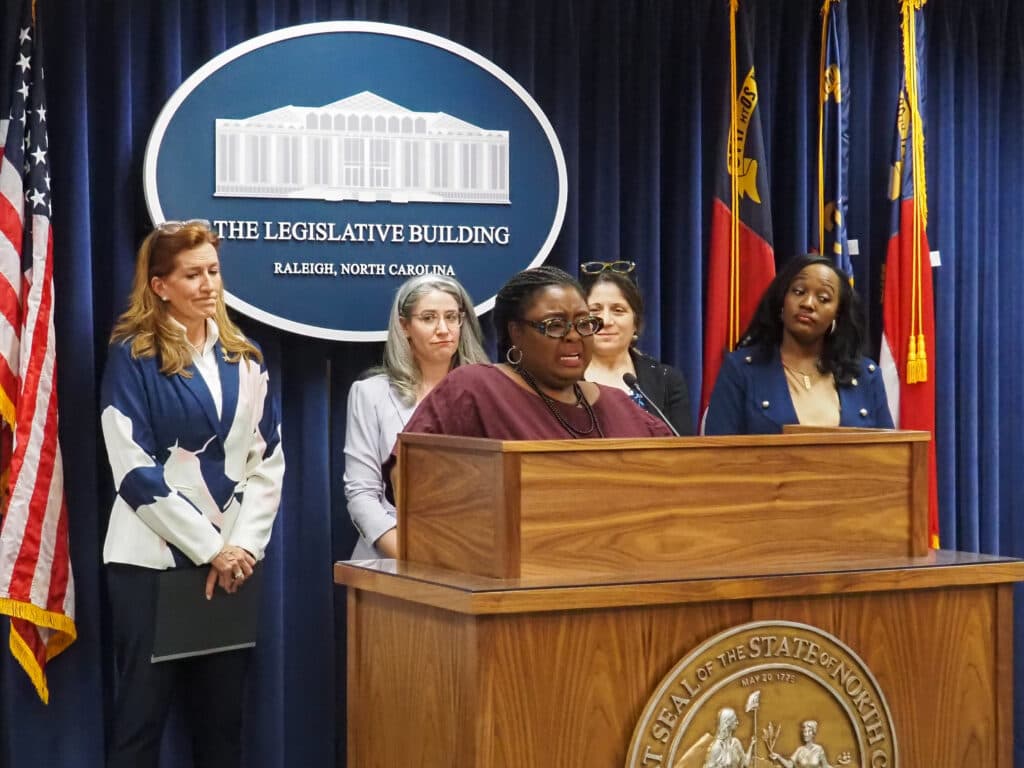
RALEIGH, NORTH CAROLINA — Three North Carolina Democratic state senators joined reproductive rights advocates Tuesday to address concerns about constitutional protections for contraception access, speaking on the 61st anniversary of the landmark Supreme Court case that established those rights.
Senators Sophia Chitlik (D-Durham), Woodson Bradley (D-Mecklenburg), and Natalie Murdock (D-Durham) gathered at the state capitol to promote Senate Bill 413, legislation they co-sponsored that would codify contraception access rights established in Griswold v. Connecticut into North Carolina state law.
Senators Cite National Concerns
“The promise of Griswold was that these deeply personal decisions belong to individuals, not politicians. Today, we are here to say that promise still matters, and we will continue fighting to protect that here in North Carolina and beyond,” Murdock said during the press conference.
The senators pointed to nationwide challenges to reproductive rights following the 2021 Supreme Court decision in Dobbs v. Jackson Women’s Health Organization, which overturned the constitutional right to abortion established in Roe v. Wade.
U.S. Supreme Court Justice Clarence Thomas wrote in his concurring opinion in the Dobbs case that the right to privacy underlying Roe should be questioned. Thomas stated the Supreme Court “should reconsider” other rulings built on similar privacy foundations, specifically mentioning Griswold v. Connecticut.
State-Level Restrictions Spreading
Since the Dobbs decision, 14 states have created potential pathways to challenge contraceptive access by legally affirming that life begins at conception, according to the senators and advocates present. Alabama became the first state to take this approach after its supreme court ruled that life starts at fertilization.
While Alabama’s ruling initially targeted in vitro fertilization treatments, reproductive rights advocates argue the legal precedent could threaten access to intrauterine devices and other forms of contraception that prevent fertilized eggs from implanting.
Dawn Blagrove with Emancipate NC also spoke at Tuesday’s event, emphasizing the need to maintain contraceptive access protections at the state level.
Legislative Response
Senate Bill 413 represents the Democratic lawmakers’ effort to shield North Carolina residents from potential federal rollbacks of contraception rights. The proposed legislation would enshrine into state law the same protections established by the 1965 Griswold v. Connecticut decision.
The Griswold case established that married couples had a constitutional right to use contraception, a decision later expanded to include unmarried individuals. The ruling created a foundation for privacy rights that influenced subsequent reproductive rights cases for decades.
The three co-sponsoring senators emphasized that their legislation aims to preserve individual decision-making authority over contraceptive choices, regardless of potential changes to federal constitutional interpretations.